Annwn Prize 2026
Holly Williams is an author, journalist and editor. She is a theatre critic for The Times, The Stage and The Telegraph, and the editor of the Globe theatre’s in-house magazine and the online theatre magazine Exeunt. Her novels What Time is Love? and The Start of Something are published by Orion.
An intricate, illustrated book about a poet, whose story unfolds as you turn the pages with whoever is sat next to you. A documentary you can walk around within, bringing to life the story of Claudette Colvin, the Black teenage girl who was the first to be arrested for refusing to give up her seat on an Alabama bus. A high-octane quest in a world of dystopian surveillance, conducted through a smartphone controlled by your eye movements. And a dark room illuminated by thousands of tiny lights, that ripple as you walk around them while a voiceover invites you to consider the fleeting nature of time itself.
What could possibly link such works? The answer, at its simplest, is: you.
Each are examples of immersive storytelling, where an audience member steps into a world, and has a degree of agency in how they experience an artwork – as opposed to sitting down passively in front of a stage or screen to watch a narrative play out.
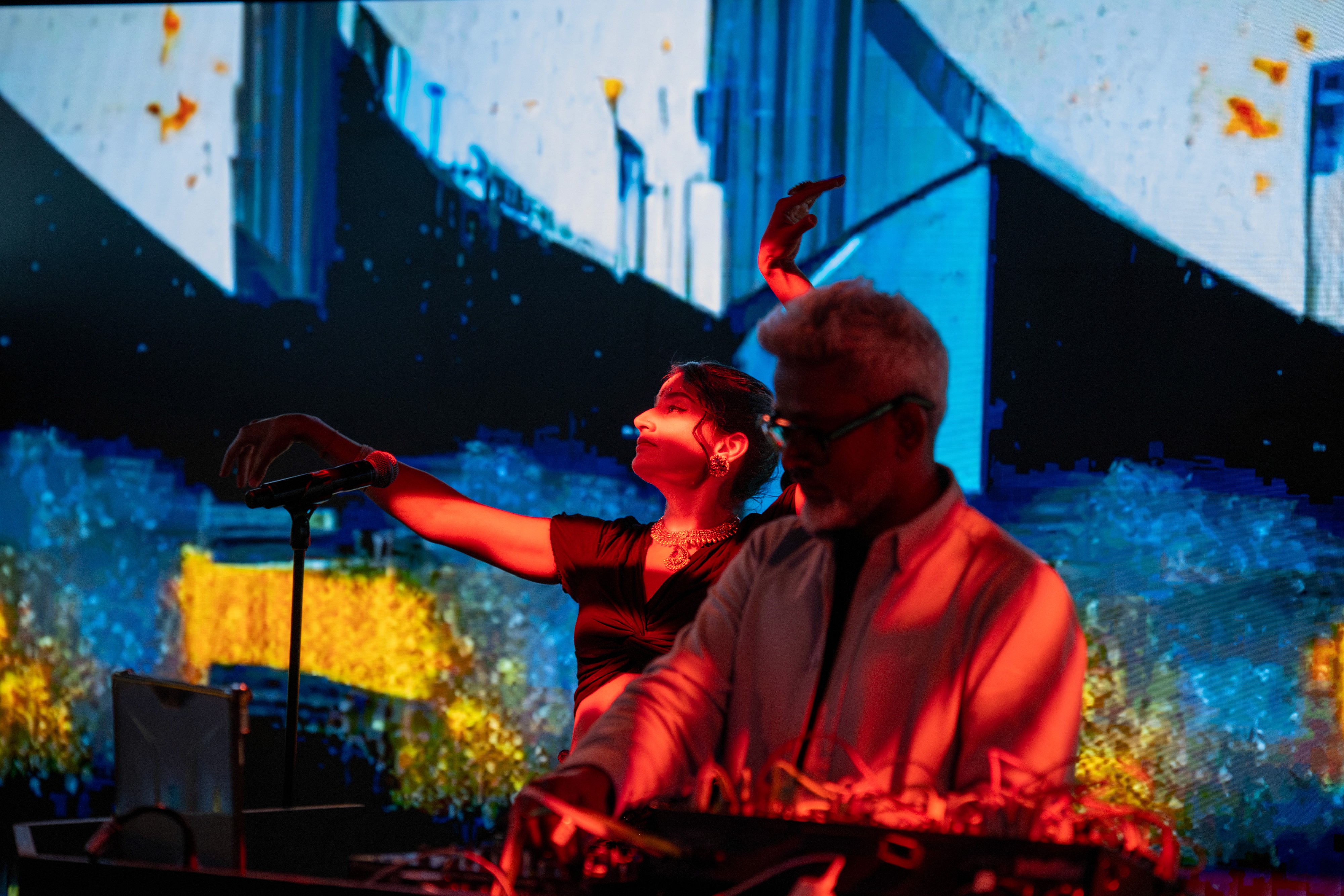
But the other reason these four works are connected is rather more concrete: they make up the shortlist for the inaugural, international Annwn Prize. The first award of its kind, it recognises excellence in immersive storytelling using creative technologies; launched this year by Wales Millennium Centre and Crossover Labs, the winner will receive a £20,000 prize. The public can experience Constantinopoliad, Colored (Noire) – The Unsung Life of Claudette Colvin, Consensus Gentium, and NOWISWHENWEARE (The Stars) in different spaces around the Wales Millenium Centre (WMC) in Cardiff until 26 June.
Taken together, the four experiences make for a vivid snapshot of an emerging artistic sector – and certainly showcase the breadth of work that may come under the ‘immersive experience’ banner. David Massey, Senior Producer for Creative Technology and Storytelling at WMC, hopes that the Annwn Prize will help widen audiences’ horizons about the many forms such digital storytelling can take.
“We've been known for showing more virtual reality, headset driven experiences,” he says; WMC launched Bocs, a dedicated space for immersive experiences and XR (extended reality, be that augmented, mixed, and virtual) in 2022, recognising that such work could help cultivate audiences of the future beyond their core theatre-going crowd. But only one of the four Annwn pieces – Colored (Noire) – requires audiences to wear any kind of gear, and that’s a pair of transparent HoloLens glasses rather than the by-now familiar chunky VR headsets.

Colored/Noire - Novoya - Image Credit WMC
The other experiences can feel more like an art installation. Or an intimate piece of theatre. Or a film. Or a computer game… The shortlist was whittled down from a longlist of 35 works, chosen by international curators and programmers, and reflecting the deeply multi-disciplinary nature of the work, the final judging panel includes the artist Larry Achiampong, theatre critic Arifa Akbar, television producer Sir Peter Bazalgette, pop star Charlotte Church, and the film director Charlotte Regan.
As an arts journalist and theatre critic, my own expertise lies in writing about one kind of mostly live, mostly collective storytelling – but I’m interested to see how technology might help us tell new stories, in new ways, when I visit the WMC and all four works.
So it is something of a surprise to encounter sister sylvester’s enchanting Constantinopoliad: called a work of ‘expanded cinema’, it feels more like good old-fashioned storytime. For anyone who thinks immersive storytelling is all VR headsets and whizzy tech, this is a pleasing corrective; unmistakable in its handmade craft, it has a tempting tactility.

Constantinopoliad - Sister Sylvester -Image Credit Kirsten McTernan
To explore the missing pages of the poet Constantine Cavafy’s diary, audiences are encouraged to read a small book together in pairs: turning pages, unfolding corners, unravelling notes (a bit like reading The Jolly Postman, but for grown-ups), while a light-up table helps illuminate Efrîn Özyetis’s evocatively scratchy, hand-drawn pictures. Via headphones, we also hear sylvester’s words read aloud, accompanied by Arabian music by Nadah El Shazly. There’s a gorgeously intimate quality to this experience, and the gentle interaction with – in my case – a total stranger added a sense of collaborative discovery. My only doubt was around the headphone-wearing, isolating us in an individual sound world; might one soundtrack for all, or even a live performer reading aloud to us, have felt more communal?
There was more enchantment in NOWISWHENWEARE (The Stars) – almost literally. I so entirely lost track of time, I was shocked to discover on leaving that I’d be in the installation for nearly 40 minutes. Andrew Schneider has filled a very, very dark room with a three-dimensional grid of shimmering tiny lights on hanging strings, that you walk or sit among. At times, the lights are grid-like – as if you’re standing in the middle of sparkly graph paper – or create volumes that slice and shape the space; at others, they surge in celestial bursts or shoal-like movements around you. It creates a simple wonder, a little reminiscent of stepping into Yayoi Kusama’s hugely popular infinity rooms.
But for all the talk of storytelling, NOWISWHENWEARE’s narrative is fairly abstract. It begins with a dense soundscape of birdsong, rain, gently thrumming music. The words, when they arrive, whisper about the fleetingness of time, a droll totting up of how we spend it (seven years of falling in love, yes, but also nine hours “misspelling your own name” in emails), before taking us into a sort cosmic existential crisis by pointing out that “in the history of earth there is a last time for everything” – last kiss on the forehead, last ice-cream, last tree growing. The narration may seem deeply profound, or a bit late-night stoner philosophy, depending on taste; I vacillated, but still found myself sinking deeply into the experience, relishing it.

If NOWISWHENWEARE asks us to consider the whole universe, Consensus Gentium brings the attention sharply back down to a device in all our pockets: the smartphone. Set in a near-future dystopia, Karen Palmer’s interactive film plays out entirely on a phone, which tracks your eye movements to affect outcomes. The production values are high: it convincingly feels like you are flicking between apps, texting your mum and friends, and signing up for a sinister new app that turns citizens into tools of surveillance.
Consensus Gentium is horribly plausible, tautly crafted, and darkly funny. But I found the eye tracking, while initially engaging, started to feel like a bit of a red herring. How much control can you actually have? Or is it really a set narrative with a gloss of interactivity? In a piece about the need to protect our own agency, the actual opportunities for doing so felt frustratingly unclear to me at times.

In Colored (Noire), the audience can’t take charge or try to change history – but we are invited to step into someone else’s reality. Stéphane Foenkinos and Pierre-Alain Giraud have turned a biographical essay about Claudette Colvin by Tania de Montaigne into an augmented reality work, layering holograms of key people and places over a space that the audience can move around. The bus that Colvin refused to give up her seat on materialises in front of us; it dissolves, and we’re in a prison cell with Colvin, or a courtroom.
The history is fascinating, and essential – exploring whose bravery gets celebrated, and who gets forgotten for being a less ‘ideal’ victim. And the experience of navigating around the space does encourage a switched-on engagement with the material, a more active sense of bearing witness. But I had some mixed feelings about the mode of storytelling. The narrated voiceover tells us at the start “from now on, you are Black” – but does moving around a ghostly, greenish holographic take on Alabama really put me, a white woman in 2026, in a Black teenager’s shoes in Alabama in 1955? Or is it just a gimmick?
Certainly, if the novelty of the tech draws a new audience to Colvin’s story, that will be a valuable thing – I’m just not convinced that such holograms are likely to elicit greater empathy or identification than a real human doing some subtle acting in a film or on stage. But perhaps I would say that – perhaps that’s my theatre brain, craving the familiar or applying a certain lens.
Spending time with all four pieces, it is genuinely exciting to see artists using technology to push existing forms into new shapes. But talking to Massey afterwards, it seems like the genre-bending variety of work that comes under the immersive experience banner is both its selling point – and something of a struggle for the burgeoning sector.
Put simply, no-one really knows how to talk about it.
As a theatre critic and editor, who spends probably too much of my life thinking about how we talk about storytelling and also fretting about shrinking coverage of the arts, I’m interested in this question of how we might write about work that is so tricky to categorise. Where is the critical conversation at, currently?
“Well, it's nowhere,” Massey replies, frankly. “I mean, it doesn't exist. Even the festival itself, I think critics and journalists don't know how to categorise it.” He points out that the Annwn showcase was listed under ‘theatre’ in The Independent – which doesn’t feel right, even if it is within a theatre venue.
“This is one of the reasons why Annwn exists, because we would like critics to start really discussing this work,” continues Massey. All art deserves thoughtful interrogation, rather than just to float in a vacuum. And as a critic I may be biased, but I think there are many reasons why stoking critical discourse is essential – especially for a new and developing category of work.
Firstly, as Massey also points out, it is what the makers themselves want and need. “They haven't had that opportunity to have their work critiqued – it's usually just done with a very small group of people who are already converted, right?” he says. Every artform needs to be met with rigour – and while no-one loves getting a negative review, bland blanket praise doesn’t actually help artists grow or develop. The championing and cheerleading of good work – which all good critics genuinely do love to do! – naturally means more when they are also willing to point out flaws and failures. Well-informed judgements and in-depth exploration of artworks not only do essential work in documenting work and how an industry is developing – charting leaps forwards and imaginatively weird side-steps, unsung gems or the hyped latest thing – but critical chatter can also help kick-start much wider conversations and debate, within and beyond the industry.

For of course, reviews, media coverage and a thriving critical discourse aren’t just for artists – they’re also vital for audiences. Yes, a lot of potential audiences will find this kind of work through online influencers or authentic word-of-mouth recommendations – but there’s still real value in having experienced, passionate critics offering thoughts that can help audiences make sense of what they’re watching, situate it within a wider context, or even just reassure them that something is worth their time and money. Especially while there can still be “confusion”, as Massey acknowledges, over what exactly some immersive experiences even are, having vocal champions with real expertise could be game-changing.
But there’s the rub: given immersive work crosses so many disciplines, and is considered so uncategorisable, how do you develop a critical language, an artistic standard, a body of expertise? Who even should be writing about it?
As a theatre critic, I admit that I had some nerves at the thought of passing down verdicts on this kind of work, of collating my thoughts on the shortlist. I’m used to making judgements about storytelling across a huge variety of theatrical forms – including immersive theatre, which is a well-established form. I’d say that all contemporary theatre critics by now have a good feeling for if, say, immersive elements are really changing the audiences’ experience of a narrative or if they’re really just a bit of set dressing.
But the technological aspects of some of the Annwn shortlisted works are pretty far outside my wheelhouse; my knowledge of gaming is almost non-existent. Is it really fair, then, that someone like me should judge a use of tech when I don’t have a sense of if it’s cutting-edge or old-hat?
Massey is quick to suggest that we can all – from journalists to audiences to marketeers – get a bit too hung up on the tech aspects: “I honestly think that the story is the most important thing,” he insists. “For us, the technology is actually just a tool. What is important is that the technology that's used is fitting for the story.”
And what critics of this work really need, he suggests – rightly, I think – is to simply see more of it: “The more you see, the more you understand.” It’s the same with any artform, and it’s how any new critic develops their taste, their insights. And it’s why Massey is determined to bring immersive experiences out of niche film festivals or galleries and into “these kind of public spaces”: so we can all, audiences and critics alike, start going to them, and talking about them, and figuring out for ourselves what we love and what leaves us cold.
Still, I feel like such multi-disciplinary work could benefit from some critical skills sharing – I’d be fascinated to compare my responses to the shortlist with a gamer, an art critic, a film buff. Much like the panel for the Annwn Prize asking judges from different industries to decide together on a winner, it feels like it would be helpful to start conversations between critics who are already experts in different fields, to share notes and compare opinions.
But in an era when it can be hard for even long-established theatres and galleries to get coverage in news outlets, and column inches for arts reviews are perpetually shrinking, I’m aware that would be a big ask. Perhaps immersive experiences need to forge their own critical space – drawing critics from different disciplines, with an emphasis on discussion and debate? In the theatre website Exeunt, which I edit, alongside solo authored pieces, the group dialogue format has long been a staple – as a way for critics (and sometimes artists and industry figures) to stop pretending that we always have a clear-cut verdict, and to instead thrash ideas and opinions out together.
Could this be a solution to the dearth of critical discourse around immersive experiences – to acknowledge that, as a new industry grows and develops, so too will the conversation around it? Writers don’t actually have to have all of the answers, all the time – but can learn from the work, and from each other.
The Annwn Prize is at Wales Millenium Centre, Cardiff to 26 June.